Push-In vs Pull-Out Services: Navigating the Best Approach for Your Child

Understanding Push-In vs Pull-Out Services
In the world of special education and therapy, push-in and pull-out services are common models for delivering support to students. Understanding these can help you make informed decisions about what might work best for your child. This article is part of our complete guide to Working with the School SLP, OT, and Counselor: A Parent's Playbook.
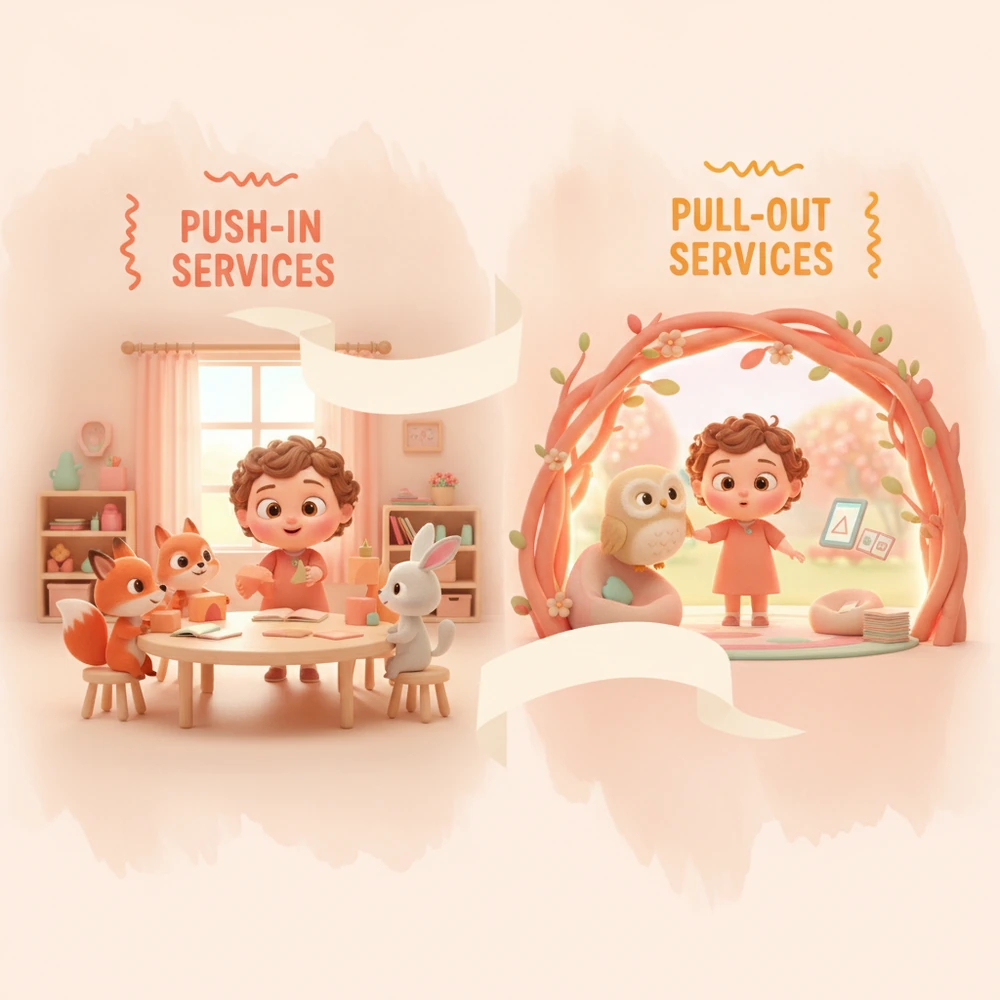
Push-in services involve therapists, like Speech-Language Pathologists (SLPs), working directly in the classroom. They collaborate with teachers to integrate therapy into everyday learning. Pull-out services, on the other hand, mean the child leaves the classroom for individual or small group sessions with the therapist in a separate setting.
Both models have distinct advantages and challenges. Here, we delve into these to help you decide what aligns best with your child's needs.
The Pros of Push-In Services
Generalization and Peer Modeling
One of the key benefits of push-in services is the opportunity for generalization. Skills learned in therapy can be immediately applied in the classroom, aiding in their integration into everyday activities. This approach supports the CASEL competency of self-management, as children practice skills in real-world settings.
Imagine a child learning new communication strategies within a math lesson. This immediate application can enhance retention and relevance.
Peer modeling is another significant advantage. Children observe and mimic their peers, which can be particularly beneficial for social skills development. In my practice, I've seen children thrive by watching their classmates use newly taught strategies, gradually incorporating them into their interactions.
Reduced Stigma
Staying in the classroom reduces the stigma associated with leaving for "special help." This can be crucial for maintaining a child's self-esteem and promoting social awareness. They feel part of the group, which can foster a sense of belonging and acceptance.
Moreover, being in a familiar environment can encourage children to take risks in their learning, knowing they are supported by both peers and teachers. This can lead to increased confidence and a more positive attitude toward learning challenges.

The Cons of Push-In Services
Classroom Noise and Distractions
A potential downside is the classroom environment itself. Noise and distractions can make it difficult for some children to focus on therapy tasks. This setting might not suit children who need a highly controlled environment to concentrate.
Example Situation: Consider a child named Alex who struggles with auditory processing. During a push-in session, the bustling classroom may hinder Alex's ability to focus on specific language tasks. In such cases, the effectiveness of therapy might be compromised.
Furthermore, the dynamic nature of a classroom can sometimes lead to interruptions that disrupt the flow of therapy. This can be challenging for therapists trying to maintain a structured session.
Less Individualized Attention
Push-in services may also offer less individualized attention, as therapists must balance the needs of the entire class with individual goals. For some children, the presence of peers might be more distracting than beneficial, leading to reduced focus on personal targets.
However, therapists often employ strategies such as small group work within the classroom to mitigate this, ensuring that each child still receives targeted support.
The Pros of Pull-Out Services
Focused, Distraction-Free Environment
Pull-out services provide a quiet, controlled space where children can receive undivided attention from their therapist. This environment is ideal for intensive skill-building without interruptions, supporting the CASEL competency of responsible decision-making by teaching children to focus and engage deeply.
Scripted Dialogue:
- Therapist: "Let's work on your 's' sounds. Can you say 'sun'?"
- Child: "Sun."
- Therapist: "Great! Let's try 'sand' next."

This one-on-one setting allows therapists to adjust the pace and complexity of activities to match the child's immediate responses, optimizing the learning experience.
Tailored Instruction
In a pull-out session, the therapist can tailor activities specifically to the child's IEP goals, ensuring that the intervention is highly focused and effective. This personalized approach often leads to quicker progress in targeted areas.
Additionally, the therapist can incorporate the child's interests into sessions, enhancing engagement and motivation. For example, using a child's favorite story character in language exercises can make learning more appealing and relatable.
The Cons of Pull-Out Services
Limited Generalization
A significant downside is that skills learned in isolation may not easily transfer to the classroom. Children might struggle to apply new skills in the dynamic environment of their regular class, which can hinder relationship skills development.
For instance, a child may successfully articulate sounds during therapy but face difficulty doing so amidst the classroom's varied stimuli. Integrating these skills into daily classroom activities can be challenging without consistent reinforcement.
Missed Class Time
Children may miss important class activities, leading to gaps in their learning or social experiences. Balancing therapy needs with classroom engagement is crucial to avoid falling behind academically or socially.
Teachers and therapists can collaborate to ensure that the child is not missing critical parts of the curriculum, perhaps by scheduling sessions during less critical times or providing catch-up work.
Deciding Between Push-In and Pull-Out
Student Profile
Consider your child's unique needs. Children who benefit from hands-on learning and peer interaction may thrive with push-in services. Those who require minimal distractions might do better with pull-out sessions.
In My Practice: I've seen many parents weigh these factors by observing trial sessions of each model. This firsthand experience often clarifies which environment their child responds to best.
Goal Type
The nature of the therapy goals is also critical. Skills requiring fine-tuning or intensive practice, like speech articulation, may benefit from pull-out. Social skills and language use might be better supported in a push-in setting.
For example, a child working on social pragmatics may benefit more from practicing these skills in a real-world context, surrounded by peers, rather than in isolation.
Classroom Culture
The classroom environment and teacher's flexibility in collaborating with therapists can influence the decision. A supportive classroom culture can enhance the effectiveness of push-in services.
If teachers are open to incorporating therapy strategies into their lessons, children may find it easier to apply what they've learned across different subjects and settings.
When to Consider a Hybrid Approach
In some cases, a hybrid model combining both push-in and pull-out services might be ideal. This approach allows for focused skill-building in pull-out sessions while ensuring those skills are generalized and reinforced in the classroom.
Example Case Study: Picture a student named Jamie. Jamie receives weekly pull-out sessions for speech practice but also benefits from biweekly push-in sessions where these skills are applied in group storytelling activities. This blend addresses both Jamie's specific needs and broader social skills.
Hybrid models can be particularly effective for addressing a wide spectrum of needs, ensuring that therapy remains holistic and integrated with daily learning activities.
References
1 Cirrin, F. et al. (2010). Evidence-based outcomes of school-based language interventions. ASHA. Retrieved from PubMed
2 ASHA — School-based services for SLPs. Retrieved from ASHA.org
Try It This Week
Reading is the easy part. Skills build through small, repeated practice — here's a low-pressure plan you can try with your child.
- 1Observe a Push-In SessionDay 1Watch a push-in session at your child's school to see how therapy integrates with classroom activities.Learn more about SEL integration →👉 What this looks likeAttend a math lesson where the therapist is working with the class. Notice how the therapist supports language skills during the activity. For example, if the class is counting, observe how the therapist encourages your child to participate and uses peer interaction to reinforce learning.
- 2Discuss with the TherapistDay 2-3Meet with your child's therapist to discuss the benefits of each model for your child.👉 What this looks likeSchedule a meeting with the therapist and ask specific questions about how each model might benefit your child. Use examples from the push-in session you observed to guide the discussion.
- 3Trial a Hybrid ApproachThis weekendTry combining both models to see which best suits your child.Explore hybrid models →👉 What this looks likeRequest a week where your child has both push-in and pull-out sessions. Observe any changes in behavior or skill use in different settings. Note if your child seems more engaged or if there's an improvement in applying skills learned.
- 4Reflect on Classroom CultureOnce this weekConsider how the classroom environment affects your child's learning and therapy.Read about classroom culture impacts →👉 What this looks likeTalk to your child's teacher about the classroom dynamics. Are there opportunities for your child to lead a group activity? Discuss how these can be leveraged to enhance learning outcomes and therapy effectiveness.
- 5Evaluate ProgressNext weekAssess your child's progress in both settings to determine the best approach.👉 What this looks likeAfter a week of observing both models, sit down with your child and therapist to review progress. Discuss which setting your child feels most comfortable and effective in, using specific examples like improved participation or reduced frustration.
Frequently Asked Questions
What are push-in services?
What are pull-out services?
How do I choose between push-in and pull-out?
Can a hybrid model be beneficial?
What is the benefit of peer modeling in push-in services?
References