Emotion Charts for Autistic Kids: Personalized Approaches for Better Emotional Understanding

Understanding and managing emotions is an essential skill for children, especially those who are neurodivergent. Using tools like emotion charts can aid in this process, but standard face-based emotion charts often fall short for autistic children. This article is part of our complete guide to Emotion Charts and Wheels: A Parent's Complete Guide. Let's explore why these charts may not be effective for all autistic kids and what alternatives exist.
Why Standard Face-Based Charts Fail Many Autistic Kids
Standard emotion charts typically use simple cartoon faces to represent different emotions. However, many autistic children struggle with recognizing and interpreting facial expressions due to differences in processing social cues. This can make face-based charts less effective and sometimes even confusing.
For instance, if a child finds it challenging to distinguish between a "happy" face and a "surprised" face, they might misinterpret the chart, leading to frustration instead of clarity. In my practice, I've seen that when families switch to more personalized approaches, children often show improved emotional understanding.
Alternative Approaches
To support autistic children, parents and educators can explore alternatives to standard charts. Custom visuals tailored to the child’s interests or incorporating simple color codes can be more effective. Additionally, using story-based tools or interactive games that allow children to express emotions through actions or role-playing can significantly improve comprehension. These methods align with the CASEL competencies, particularly enhancing self-awareness and social awareness.
Alexithymia + Interoception Research
Alexithymia, a condition where individuals have difficulty identifying and describing their emotions, is more common in autistic individuals. This challenge is compounded by differences in interoception, which is the awareness of internal body states 2.
For autistic children, these interoceptive differences mean they might not feel emotions in the same way or as intensely as neurotypical peers. This affects how they interpret emotion charts. A child might struggle not just with identifying facial expressions but also with recognizing the bodily sensations associated with emotions.
Example: Recognizing Emotion Through Sensations
Imagine your child feels "nervous" but doesn't recognize it as such. Instead of asking them to identify a face, guide them to notice body cues: "Do your hands feel sweaty? Is your heart beating fast?" These sensations are easier for some children to recognize than expressions on a chart.
In My Practice
In my practice, I encountered a family who used a simple routine of asking their child to place a hand on their chest and describe the sensation when they appeared upset. Over time, this helped the child recognize their body's signals for anxiety, aiding in emotional identification and regulation.
The 5-Point Scale (Buron) as Alternative
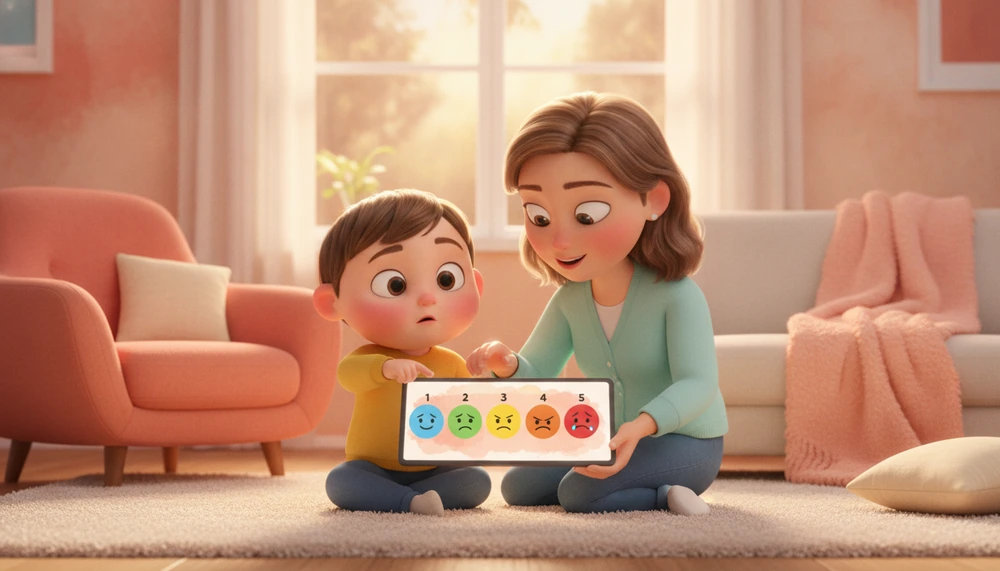
The 5-point scale, developed by Kari Dunn Buron, provides a structured way to help children understand and manage their emotions 1. This tool breaks down emotions and reactions into five simple levels, allowing children to express how they feel more accurately.
Using the 5-Point Scale
- Introduce the Scale: Begin by explaining the scale to your child. Level 1 might mean "calm," while level 5 could mean "very upset."
- Apply to Real Situations: Use scenarios your child frequently encounters. Ask, "If someone accidentally bumps into you, what level would that be?"
- Role-Play: Practice with simple role-playing exercises where you act out situations and discuss which level they might be.
Example: Implementing the Scale
Consider a child, Alex, who gets overwhelmed easily. Using the 5-point scale, his parents help him rate his feelings during different activities. When Alex felt anxious about a school presentation, he placed himself at a "4." His parents then guided him through calming techniques to bring it down to a "2," using deep breathing and visualization.
Body Sensation Maps as Alternative
Body sensation maps are another effective tool. These maps help children associate emotions with physical sensations, making it easier to identify how they feel based on what their body is experiencing.
Example: Building a Body Sensation Map
- Draw or Print a Simple Body Outline: Mark areas where emotions show up — maybe a "tight chest" for anxiety or "warm cheeks" for embarrassment.
- Color Coding: Use colors to represent different emotions and sensations. Red might indicate anger, while blue might be calmness.
- Regular Check-Ins: Encourage regular check-ins where your child updates their map. This builds self-awareness and helps them articulate feelings.

In My Practice
I've observed that children who regularly update their body maps become more attuned to their emotions, enhancing their ability to communicate needs effectively. One child began recognizing when they were tired vs. sad, which reduced meltdowns and fostered better self-management.
Special-Interest-Themed Charts
Children often engage more when learning tools incorporate their interests. For autistic kids, emotion charts themed around their special interests, like Pokemon or trains, can increase engagement and understanding.
Example: Creating a Pokemon Emotion Chart
- Identify Emotions with Characters: Use Pokemon characters to represent different emotions. Pikachu might be "happy," and Snorlax could be "relaxed."
- Interactive Play: Act out scenarios using toys or drawings to reinforce these associations.
Expanded Engagement
Engaging with special-interest-themed charts encourages children to participate actively in learning about emotions. It blends their passion with practical skills, fostering a deeper connection and understanding.
Building YOUR Child's Personalized Chart
To ensure emotion charts are effective, personalizing them to your child's unique needs and interests is crucial.
Steps to Personalization
- Observe Your Child: Note what interests them and how they naturally express emotions.
- Incorporate Interests and Sensations: Use these observations to build a chart that resonates.
- Iterate and Adjust: Regularly update the chart as your child grows and their interests change.
In My Practice
In my practice, personalization has been the key to success. I encouraged a parent to incorporate their child's love of space into their emotion chart, using planets to represent different feelings. This small change led to increased engagement and helped the child better articulate their emotions.
When to Involve an SLP
Sometimes, creating the right tools requires professional guidance. A Speech-Language Pathologist (SLP) can work with you to develop strategies tailored to your child’s communication and emotional needs. They can also provide resources such as social stories that offer additional support.
In My Practice
In my practice, I've seen many parents benefit from consulting with an SLP when initial attempts with emotion charts don't yield results. An SLP can offer insights into why a particular approach may not be working and suggest alternatives.
Using Words to Share Our Feelings and Needs - Social Story is one such resource that can complement emotion charts by enhancing communication skills.
References
1 Buron, K. (2003). The Incredible 5-Point Scale.
2 Garfinkel, S. et al. (2016). Discrepancies between dimensions of interoception in autism. Biological Psychology.
3 Mahler, K. (2017). Interoception.
Try It This Week
Reading is the easy part. Skills build through small, repeated practice — here's a low-pressure plan you can try with your child.
- 1Introduce a Body MapDay 1Create a body sensation map with your child to help them connect physical sensations with emotions.👉 What this looks likeStart by drawing a simple body outline with your child. Ask them where they feel different emotions in their body, such as a tight chest for anxiety. Use colors to represent these feelings. For example, use red for anger and blue for calmness. This visual guide can help your child recognize and articulate their emotions more clearly.
- 2Practice Using the 5-Point ScaleDay 2-3Use the 5-point scale in daily situations to help your child express and manage emotions.👉 What this looks likeDuring a calm moment, introduce the scale by explaining each level. Ask your child to use the scale to describe their feelings during a routine activity, like breakfast. If they say they're at a '3' (neutral), discuss what might make it go up or down. This practice helps them link numbers to emotional states.
- 3Create a Special-Interest ChartThis weekendIncorporate your child's interests into an emotion chart to make it more engaging.👉 What this looks likeIf your child loves dinosaurs, create an emotion chart using different dinosaur characters to represent various feelings. For example, a roaring T-Rex for "angry" or a calm Stegosaurus for "relaxed." This personalized chart can make emotional learning more enjoyable and relatable.
- 4Role-Play Emotional ScenariosDaily, 5 minUse role-playing to practice emotional responses and identification.use these stories →👉 What this looks likeSet up brief role-play scenarios with toys or puppets. Act out situations like sharing a toy or dealing with a sibling's teasing. Discuss which emotions the characters might feel and how they might respond. This helps your child practice emotional recognition in a fun, low-pressure way.
- 5Consult with an SLPOnce this weekReach out to an SLP for personalized guidance on emotion charts and communication strategies.👉 What this looks likeContact a local SLP to discuss your child's specific needs. They can help tailor strategies and provide resources like social stories to support emotional and communicative development. During the consultation, share your current approaches and seek feedback on adjustments.
Frequently Asked Questions
Why do standard emotion charts fail for autistic kids?
What is alexithymia?
How can the 5-point scale help my child?
What are body sensation maps?
When should I consult an SLP?
References